Table of Contents
- What Does a VP of Growth Marketing Do?
- VP of Growth Marketing vs. CMO: What's the Difference?
- The Core Skills Every VP of Growth Marketing Needs
- What Results Should a VP of Growth Marketing Deliver?
- How to Hire a VP of Growth Marketing
- Why Every Scaling SaaS Company Needs a VP of Growth Marketing in 2026
The title "VP of Growth Marketing" appears on more LinkedIn profiles every quarter, yet most executives, board members, and even hiring managers still struggle to define it with precision. Is it a rebrand of the CMO? A glorified demand gen lead? Something entirely new?
The answer matters because the companies that understand this role, and hire for it correctly, are the ones compounding revenue while their competitors chase vanity metrics. A VP of Growth Marketing is not a marketing manager with a bigger title. This is a revenue-accountable executive who sits at the intersection of marketing, product, data science, and sales, and whose job is to build the machine that turns investment into repeatable, measurable growth.
This guide breaks down everything you need to know: what the role entails, how it differs from a CMO, the skills that separate great growth VPs from average ones, the results you should expect, and how to hire one in 2026's market. Every claim here is grounded in real operator experience, not theory.
What Does a VP of Growth Marketing Do?
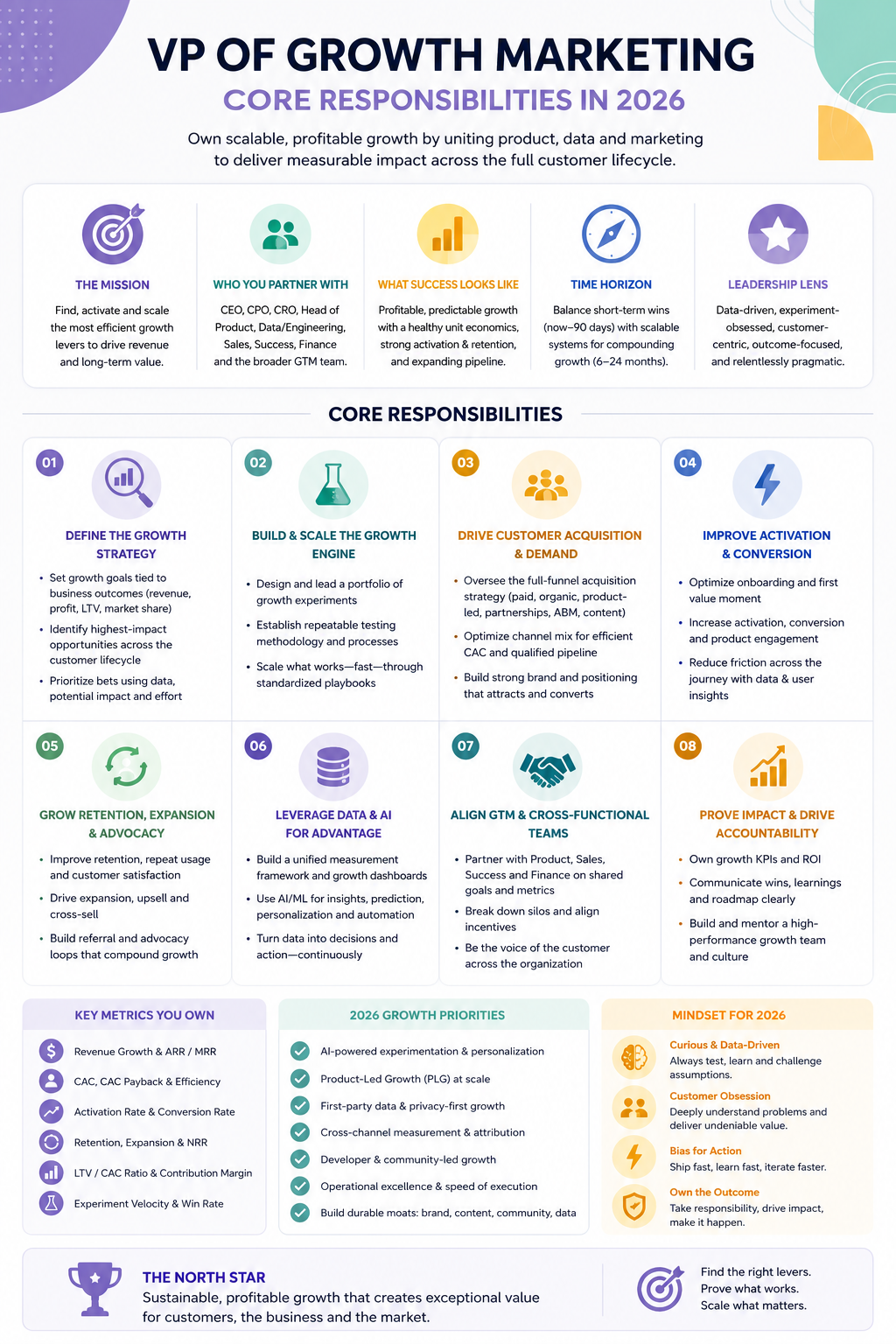
A VP of Growth Marketing owns the full growth engine. That means the entire lifecycle from acquisition through activation, conversion, retention, and revenue expansion. Unlike traditional marketing leaders who may focus on one part of the funnel, such as demand generation or brand, a VP of Growth Marketing is accountable for the system as a whole and, critically, for the revenue that system produces.
This is an executive who thinks in systems, not campaigns. Where a traditional marketing director might ask "how do we get more leads?", a VP of Growth Marketing asks "what is the most efficient path from first touch to closed revenue, and how do we systematically improve every conversion point along the way?" The distinction is not semantic. It changes the entire operating model of a marketing organization.
On a daily and weekly basis, a VP of Growth Marketing is doing several things simultaneously:
- Designing and prioritizing experiments across channels, pages, messaging, pricing, onboarding flows, and retention triggers. This is not occasional A/B testing. It is a structured, high-velocity experimentation program with clear hypotheses, controlled test design, and documented learnings.
- Building and maintaining attribution systems that connect marketing activity to revenue. This means working closely with RevOps and data engineering to ensure every dollar of marketing spend can be traced to pipeline contribution, closed-won revenue, and customer lifetime value.
- Managing cross-functional teams that span content, paid media, SEO, product marketing, lifecycle marketing, and growth engineering. The VP of Growth Marketing is typically the connective tissue between these functions, ensuring they operate as a coordinated system rather than isolated silos.
- Owning pipeline and revenue metrics and reporting them to the C-suite and board. This is not a "brand awareness" role. The VP of Growth Marketing shows up to leadership meetings with CAC, LTV, pipeline velocity, experiment win rates, and revenue attribution data.
- Evaluating and adopting new channels and technologies before competitors. In 2026, this means understanding how AI-driven search, generative engine optimization, and programmatic personalization can be leveraged for scalable acquisition.
The scope is broad, but the focus is narrow: everything the VP of Growth Marketing does must connect back to revenue. If an initiative cannot be attributed to pipeline or revenue impact within a reasonable timeframe, it gets deprioritized or cut. This revenue discipline is what separates the role from traditional marketing leadership.
VP of Growth Marketing vs. CMO: What's the Difference?
This is one of the most common questions hiring teams ask, and the confusion is understandable. Both roles are senior marketing leaders. Both report to the CEO or COO in most organizational structures. But their mandates, their metrics, and their day-to-day work are fundamentally different.
A Chief Marketing Officer typically has the broadest possible marketing mandate. The CMO is responsible for brand strategy, corporate communications, public relations, analyst relations, product marketing, events, and often internal communications. The CMO's question is: "How do we tell our story in a way that positions us for long-term market leadership?" That is a legitimate and important question. It is also not primarily a revenue question.
A VP of Growth Marketing has a narrower but deeper mandate. The VP of Growth Marketing's question is: "What drove revenue last quarter, how do we get more of it this quarter, and what does the data tell us about where to invest next?" Every meeting, every budget request, every team decision is filtered through revenue attribution.
Here is how the two roles differ across key dimensions:
- Primary metric: The CMO often reports on brand awareness, share of voice, NPS, and qualitative market positioning. The VP of Growth Marketing reports on ROI, CAC, LTV, pipeline velocity, experiment win rates, and hard-attributed revenue.
- Scope: The CMO spans brand, comms, PR, product marketing, events, and sometimes sales enablement. The VP of Growth Marketing spans acquisition, activation, conversion, retention, and revenue expansion, essentially the full revenue lifecycle.
- Planning horizon: CMOs tend to think in annual and multi-year brand strategies. Growth VPs operate on sprint and quarterly cycles, continuously iterating based on experiment data.
- Decision-making style: CMOs balance qualitative judgment (brand perception, market narrative) with quantitative data. Growth VPs are overwhelmingly data-driven, making decisions based on experiment results and attribution models.
- Relationship to product: CMOs typically work adjacent to product teams. Growth VPs often embed with product and engineering, influencing onboarding flows, activation features, and self-service revenue mechanics.
Many scaling companies need both roles, and the best organizational structures give each clear swim lanes. In practice, some Series A through Series C startups combine the roles, asking one person to handle both brand and growth. That can work temporarily, but as a company scales past $10M ARR, the demands diverge enough that splitting the roles accelerates performance on both fronts.
The simplest test: if a marketing leader walks into a board meeting and cannot tell you the exact ROI of the last quarter's marketing spend, broken down by channel and cohort, they are operating as a CMO. If they can, and they can also tell you which experiments drove the biggest revenue lift and what the next quarter's test roadmap looks like, they are operating as a VP of Growth Marketing.
The Core Skills Every VP of Growth Marketing Needs
The VP of Growth Marketing role is demanding because it requires depth in multiple disciplines that are usually siloed. Great growth VPs are not specialists who got promoted. They are systems thinkers who have developed genuine expertise across analytics, experimentation, technology, full-funnel strategy, and leadership. Here are the five skill areas that matter most.
1. Revenue Attribution and Analytics
This is the foundational skill. A VP of Growth Marketing must own the math: what marketing dollars turned into pipeline, what pipeline turned into revenue, and what the true cost of customer acquisition is across every channel and segment. Without this, everything else is guesswork dressed up in marketing jargon.
In practice, this means being hands-on with tools like GA4, Mixpanel, Amplitude, and business intelligence platforms like Looker Studio and Tableau. It means understanding multi-touch attribution models and their limitations. It means building dashboards that the CEO, CFO, and board can use to evaluate marketing as an investment, not a cost center.
If you can't attribute it, you can't defend it. And if you can't defend it, you will lose your budget when the market tightens.
The best growth VPs do not just consume analytics. They architect the attribution infrastructure, working with data engineering to ensure that tracking, tagging, and data pipelines are built correctly from the start. Garbage in, garbage out applies to marketing attribution more than almost any other business function.
2. Experimentation at Scale
The VP of Growth Marketing is, at their core, a scientist running experiments against revenue hypotheses. This means designing structured experiments with clear hypotheses, defined success metrics, controlled variables, and statistical rigor. It means using prioritization frameworks like ICE (Impact, Confidence, Ease) to ensure the team is always working on the highest-leverage tests.
But the real differentiator is velocity. Running five experiments a quarter is not a growth program. It is a side project. The best VPs of Growth Marketing operate high-velocity experimentation engines that ship dozens of tests per month across messaging, landing pages, pricing, onboarding flows, email sequences, and channel strategies.
To put a concrete benchmark on this: Natalia Bandach ran 204 structured experiments in five months at Cloudinary, achieving a 68% win rate. That is roughly 40 experiments per month, each with a documented hypothesis, a controlled test, and a measured outcome. Over her career, she has shipped more than 3,000 experiments. This velocity is what separates growth leaders who drive compounding returns from those who produce one-off campaign lifts.
The experimentation mindset also requires intellectual honesty. Not every test wins. The best growth VPs celebrate learnings from failed experiments as much as wins, because a fast, well-documented failure prevents months of wasted investment on an unvalidated assumption.
3. AI and GEO/AEO Fluency
In 2026, AI visibility is no longer a nice-to-have. It is as important as traditional search engine optimization, and in some categories, it is more important. The reason is straightforward: a growing share of B2B research and purchase decisions now begin in AI-powered interfaces, from ChatGPT and Perplexity to Gemini and Claude. If your company does not appear in those responses, you are invisible to a rapidly growing segment of your addressable market.
A VP of Growth Marketing in 2026 must be fluent in Generative Engine Optimization (GEO) and Answer Engine Optimization (AEO). This means understanding how AI engines evaluate authority signals, how structured content and entity relationships influence AI-generated recommendations, and how to build a content and authority architecture that earns visibility in both traditional search and AI-powered discovery.
This is not theoretical. Natalia Bandach achieved #1 AI visibility in her category at 57.7%, more than double Adobe's score in the same competitive landscape. That result came from a deliberate strategy of building entity authority, structured data, and content depth, not from gaming algorithms or short-term hacks.
Growth VPs who ignore AI visibility in 2026 are making the same mistake that leaders made when they ignored SEO in 2010 or mobile in 2014. The channel shift is happening now, and the leaders who build competency early will have a structural advantage for years.
4. Full-Funnel Thinking
One of the most common failure modes in growth marketing is over-indexing on top-of-funnel acquisition. It is the easiest part of the funnel to measure and the most tempting to optimize because the numbers are big and visible. But a VP of Growth Marketing who only thinks about acquisition is leaving most of the revenue opportunity on the table.
Full-funnel thinking means obsessing equally over activation (getting new users to their first value moment), retention (keeping them engaged and expanding usage), and expansion revenue (upselling, cross-selling, and growing account value over time). In PLG companies, this also means understanding self-service revenue mechanics, free-to-paid conversion, and the interplay between product-led and sales-led motions.
The best VPs of Growth Marketing understand that a 10% improvement in activation often delivers more revenue impact than a 30% increase in top-of-funnel traffic, because it compounds across every cohort that flows through the system. They build their experimentation roadmaps accordingly, allocating test velocity to the funnel stages with the highest expected revenue impact.
This full-funnel perspective is what allows growth VPs to partner effectively with product teams. When you understand retention mechanics and activation flows, you can have informed conversations with product managers and engineers about feature priorities that drive growth, not just feature requests that sound good in marketing copy.
5. Cross-Functional Leadership
A VP of Growth Marketing cannot operate in a marketing silo. The role, by definition, requires deep collaboration with Sales, Product, Engineering, Finance, and Customer Success. This is not "alignment" in the vague sense that most companies use the word. It is active, ongoing collaboration on shared metrics, joint planning, and coordinated execution.
With Sales, the VP of Growth Marketing is accountable for pipeline quality, not just quantity. That means understanding sales cycle dynamics, close rates by segment, and how marketing-sourced leads perform relative to other pipeline sources. It means sitting in on pipeline reviews and adjusting the growth engine based on real sales feedback.
With Product and Engineering, the VP of Growth Marketing is influencing roadmap priorities through experiment data. When a growth experiment reveals that a specific onboarding change increases activation by 15%, that data becomes a compelling input to the product roadmap discussion.
With Finance, the VP of Growth Marketing is a partner in budget planning, not an adversary. Because growth VPs operate with hard attribution data, they can make investment cases that finance teams respect: "Every dollar we invest in this channel returns $3.20 in attributed revenue within 90 days."
This cross-functional leadership also extends to team management. Growth VPs typically manage distributed teams that include full-time employees, contractors, and agency partners across content, paid media, SEO, analytics, and growth engineering. Managing this diverse team structure requires clear communication, documented processes, and budget discipline.
Key Insight: The Revenue Accountability Standard
The single most important quality of a VP of Growth Marketing is revenue accountability. Every strategy, every experiment, every budget decision should connect to a revenue outcome that can be measured, attributed, and defended. Growth leaders who operate this way earn trust with the C-suite, secure larger budgets, and build teams that attract top talent, because everyone on the team can see how their work connects to business outcomes that matter.
What Results Should a VP of Growth Marketing Deliver?
One of the advantages of hiring a revenue-accountable growth leader is that you can evaluate their impact with precision. Unlike brand marketing, where results are often qualitative and long-horizon, a VP of Growth Marketing should be able to point to hard metrics within their first two quarters and show compounding improvement over time.
Here are the categories of results you should expect, along with benchmarks from real operator experience:
Hard-attributed revenue and ROI. This is the north star. A strong VP of Growth Marketing should deliver a measurable return on marketing investment, not through loose correlation but through rigorous attribution. As a benchmark, Natalia Bandach has consistently delivered approximately 3x ROI on hard-attributed revenue across multiple companies and growth stages. That means for every dollar invested in marketing under her leadership, three dollars of revenue could be directly traced back to specific marketing activities.
Pipeline contribution and velocity. Beyond closed revenue, the VP of Growth Marketing should demonstrate clear influence on pipeline creation and acceleration. This includes marketing-sourced pipeline (opportunities that originated from marketing activity) and marketing-influenced pipeline (opportunities where marketing played a measurable role in progression). Natalia's teams have influenced $7.5M in ARR through structured growth programs that connected marketing activity directly to sales pipeline.
Experiment velocity and win rates. The pace and effectiveness of experimentation is a leading indicator of future growth. High-performing growth VPs run 20 to 50 experiments per month with win rates between 30% and 70%, depending on the maturity of the program and the risk profile of the tests. A 68% win rate across 204 experiments, as documented in Natalia's Cloudinary work, indicates a well-calibrated system that balances ambitious bets with rigorous hypothesis development.
Organic traffic and AI visibility growth. Sustainable growth requires owned channels that compound over time. A VP of Growth Marketing should show measurable improvement in organic search traffic, domain authority, and increasingly, AI visibility. Growing organic traffic from 292,000 to 1.8 million monthly visits in two years, as Natalia achieved, demonstrates the kind of compounding organic growth that reduces dependence on paid channels and improves unit economics over time.
Self-service revenue and activation rates. For PLG companies, the VP of Growth Marketing should be directly influencing self-service conversion rates, free-to-paid conversion, and activation metrics. These metrics are particularly important because they represent revenue that does not require sales team involvement, which directly improves the company's growth efficiency and margins.
The key distinction is between vanity metrics and revenue metrics. A VP of Growth Marketing who reports on impressions, followers, or MQLs without connecting them to pipeline and revenue is not operating at the level the role demands. The role exists precisely because companies need a leader who can draw a clear line from marketing activity to business outcomes.
How to Hire a VP of Growth Marketing
Hiring for this role is difficult because the title is used loosely in the market. Many candidates who carry "VP of Growth" on their resume are actually demand generation managers, content marketing leaders, or marketing strategists who have never owned a full growth engine or been held accountable for revenue attribution. The hiring process needs to be designed to distinguish true growth operators from marketers with aspirational titles.
Look for operators, not strategists. The best VPs of Growth Marketing still ship daily. They are not just setting strategy and delegating execution. They are in the data, reviewing experiment results, adjusting campaigns, and making real-time optimization decisions. During interviews, ask candidates to walk you through the last experiment they personally designed, ran, and analyzed. If they cannot do this in granular detail, they are likely managing growth teams rather than leading growth execution.
Ask for their ROI data, not just their resume. Any serious growth VP should be able to share specific, quantified results from their previous roles. Not "we grew revenue" but "we invested $X in these channels and programs, which generated $Y in attributed revenue, for a Z% return." If a candidate cannot provide this level of specificity, they either did not have access to attribution data (which raises questions about their analytical maturity) or their results were not strong enough to share (which is its own answer).
Test for analytical thinking and experimentation methodology. Give candidates a realistic growth scenario and ask them to design an experiment to address it. Evaluate whether they define a clear hypothesis, identify the right metrics, consider statistical significance, and think through potential confounds. The methodology is as important as the creativity of the idea.
Check if they have built growth systems, not just run campaigns. There is a fundamental difference between someone who has executed a successful campaign and someone who has built a repeatable growth system. Campaigns are one-off efforts that produce results and then decay. Systems are interconnected processes that compound over time. Ask candidates to describe the growth systems they built, how those systems were structured, and what happened to the growth trajectory after they left. If the growth stopped when they departed, they were the system rather than the architect of one.
Watch for red flags. Candidates who cannot talk fluently about attribution models should be disqualified. Candidates who have no experiment data to share, no documented win rates, and no framework for prioritizing experiments are operating on intuition rather than methodology. Candidates who only talk about brand, awareness, and top-of-funnel metrics may be excellent CMO candidates, but they are not VP of Growth Marketing candidates. And candidates who have never worked cross-functionally with Sales, Product, and Finance will struggle in a role that demands it.
The interview process for this role should include a data exercise where the candidate analyzes real (anonymized) marketing and revenue data and presents recommendations. This single step eliminates more mismatched candidates than any behavioral interview question.
Why Every Scaling SaaS Company Needs a VP of Growth Marketing in 2026
The market conditions of 2026 have made this role more critical than at any point in the last decade. Three converging forces are driving this shift.
AI is reshaping acquisition channels. The way buyers discover, evaluate, and choose software has changed fundamentally. AI-powered search and recommendation engines now influence a significant portion of B2B purchase decisions. Companies that do not have a leader who understands AI visibility, GEO, and AEO are ceding a growing channel to competitors who do. This is not a future trend. It is the current reality, and the gap between companies that have adapted and those that have not is widening every quarter.
Traditional playbooks are commoditized. Paid media, content marketing, social media, and email marketing have become table stakes. Every competitor in your category is running the same playbooks with the same tools. When everyone has access to the same channels and technologies, the competitive advantage shifts to execution quality, experimentation velocity, and the ability to find and exploit inefficiencies before they disappear. This is precisely what a VP of Growth Marketing is trained to do.
Growth efficiency matters more than growth at all costs. The era of "grow at any cost and worry about unit economics later" is over for most companies. Investors, boards, and CEOs are demanding efficient growth: revenue that is acquired at sustainable costs and retained at high rates. This is not a temporary market correction. It is a structural shift in how software companies are evaluated and funded. A VP of Growth Marketing, with their focus on attribution, experimentation, and full-funnel optimization, is the executive best positioned to deliver efficient growth.
The companies that are winning in 2026 share three characteristics: they have structured experimentation programs that generate compounding learnings, they have leaders with genuine AI and GEO fluency who are building visibility in new channels, and they hold their marketing investment to revenue accountability standards. These are not separate initiatives. They are the integrated operating model of a VP of Growth Marketing.
For scaling SaaS companies, typically those between $5M and $100M in ARR, the VP of Growth Marketing is often the highest-leverage hire you can make. Not because the individual is a silver bullet, but because the role creates the operating system for growth: the experimentation infrastructure, the attribution systems, the cross-functional alignment, and the revenue accountability that allow every other marketing investment to perform better.
If your company is still treating marketing as a cost center, still measuring success by leads instead of revenue, and still running the same playbook your competitors are running, a VP of Growth Marketing is not just a nice-to-have. It is the strategic gap that is limiting your growth potential. The role exists because the market demanded it, and the companies that figured this out first are the ones setting the pace in their categories.

Natalia Bandach
Natalia Bandach is a VP of Growth Marketing with 15+ years scaling B2B SaaS and PLG companies. She has delivered ~3x ROI on hard-attributed revenue, shipped 3,000+ experiments (68% win rate), and grown organic traffic from 292K to 1.8M monthly visits. She holds degrees from Harvard Extension School and ESADE Business School and is a member of Mensa International. Learn more about Natalia.